Kitchen safety for seniors shouldn’t be an afterthought or a cute checklist — it should be treated like a medical necessity and a serious design project. The hard truth: a kitchen that isn’t intentionally designed for aging bodies is a hazard zone, not the heart of the home. Plenty of magazine-ready kitchens are one loose rug or high cabinet away from a hip fracture for anyone with arthritis, balance issues, low vision, or early dementia.
Most of these injuries are predictable and preventable. The CDC estimates that 1 in 4 Americans over 65 falls each year, and more than 3 million older adults are treated in ERs for fall injuries annually — and the kitchen is a repeat offender. So treat it the way a good rehab hospital or accessibility contractor does: a working environment to be analyzed, redesigned, and customized. These 10 tips are real accessible-design principles, not safety slogans. If you care about a senior’s independence, you don’t babyproof the kitchen — you future-proof it.
10 Kitchen Safety Tips for Seniors
Forget fluffy advice like “be careful.” If cabinets are too high, flooring is too slick, and appliances are hard to operate, you’re setting older adults up to fail. These tips focus on practical design changes that cut risk and make independent cooking enjoyable again. If you’re supporting a parent aging in place — or planning ahead for yourself — treat them like a renovation checklist and fold them into a broader room-by-room home safety plan.
Kitchen Safety for Seniors
Practical accessible-design tips and simple habit changes to reduce falls, burns, and cuts.
- Design: keep counters clutter-free, use non-slip mats, and store everyday items within easy reach to prevent trips and overreaching.
- Tools: use lightweight, easy-grip utensils, stable cookware with inward-turned handles, and a secure knife block — and prefer the microwave over the stove to lower burn and cut risk.
- Habits: test temperatures, don’t rush, and organize work zones at comfortable heights to minimize spills and accidents.
1. Keep the Kitchen Clutter-Free
Clutter is a fall hazard dressed up as “I might need this later.” It shrinks usable space, forces awkward reaching, and steals attention from real hazards like a wet floor or an open drawer. Cognitive changes make it harder to filter out unneeded items, and research on aging and executive function suggests clutter slows decision-making and increases errors — exactly what you don’t want near knives and hot surfaces. Build a system, not a one-time cleanup:
- Keep only daily-use items on the counter (coffee maker, toaster, a utensil crock).
- Designate a staging area near the stove and sink that stays completely clear.
- Remove decorative rugs, extra chairs, and storage boxes from floor paths.
- Limit fridge magnets and notes — visual clutter can be disorienting with cognitive decline.
Insider Tip: A good test used in home safety evaluations — if you can’t easily walk a laundry basket through the kitchen without bumping anything, it’s too cluttered.
2. Use Non-Slip Mats
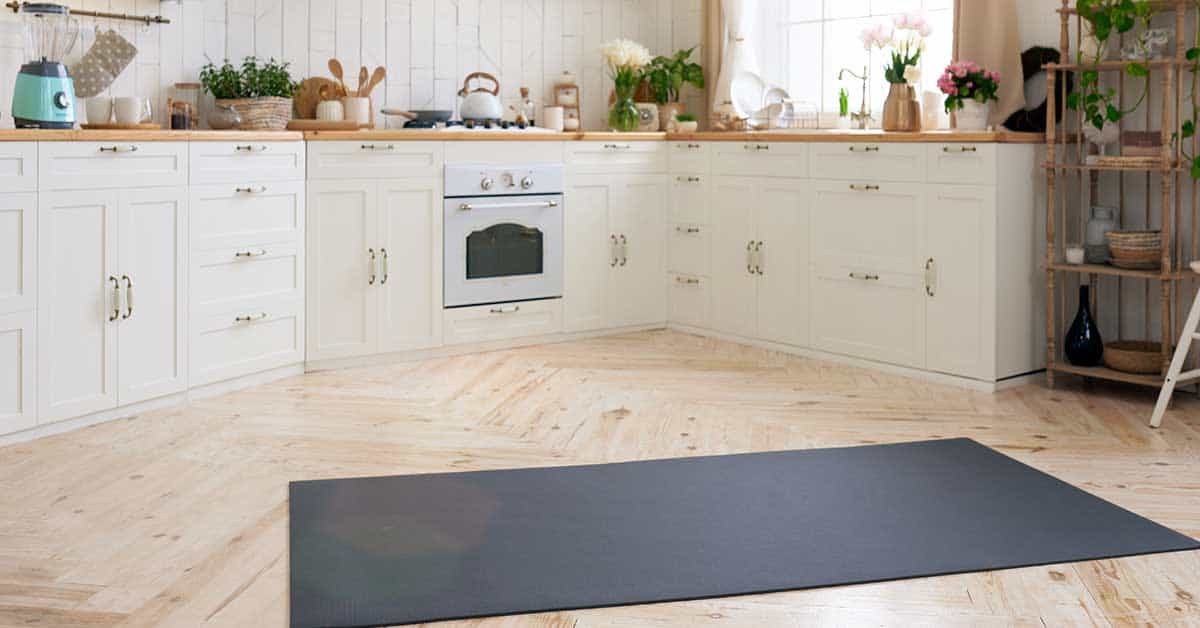
The cute, curling, unsecured kitchen rug is one of the most dangerous things in a senior’s home — a mat with no non-slip backing has sent plenty of independent older adults to the ER with a fractured wrist. Slippery tile or vinyl, plus water, plus socks is a physics problem no amount of “being careful” solves. Look for low-profile, beveled-edge mats that won’t catch toes or wheels; rubber-backed, non-skid surfaces that stay put when wet; and easy-to-clean materials that handle oil and grease. Place them in the highest-risk zones — sink, stove, main prep area — but don’t overdo it; one or two securely anchored mats beat a maze of flimsy ones.
Insider Tip: If full flooring replacement isn’t in the budget, at least test your mats — slide each one with your foot, and if it moves, it isn’t safe. Contractors often note a slip-resistant floor is “cheaper than a hip fracture and a rehab stay.”
3. Store Items Within Reach
Climbing onto a step stool to reach the good dishes isn’t independence — it’s a fall in progress. With age-related changes in balance, strength, and vision, overhead reaching, floor-level bending, and standing on anything unstable are all inherently unsafe. Design storage so 90–95% of daily tasks happen between shoulder and hip height:
- Move heavy pots, pans, and appliances into waist-high drawers or pull-outs, not high cabinets.
- Use pull-out shelves and lazy Susans so no one digs in the back of cabinets.
- Keep a single daily dish set in the easiest-to-reach spot.
- Store cleaning supplies somewhere reachable — not under the sink if bending or dizziness is an issue.
Insider Tip: Design for future limitations, not current ability. Even if your loved one can still reach high shelves now, assume that in five years they won’t — and set the kitchen up for that reach today.
4. Use the Right Tools
Most kitchen tools are designed for strong, nimble hands with perfect vision — a design failure for anyone with arthritis, tremors, neuropathy, or reduced grip. Adapted tools aren’t a luxury; they’re safety equipment:
- Ergonomic utensils with thicker, padded handles.
- Lightweight pots and pans — heavy cast iron is brutal on weak wrists.
- Electric openers for cans and jars, plus an electric kettle.
- Rocking knives or mezzalunas for limited hand strength or tremors.
Research on arthritis and kitchen tasks shows adapted tools reduce pain and fatigue, which means fewer rushed, risky movements — and seniors who cook more instead of defaulting to ultra-processed food.
Insider Tip: Make the adapted tools the default and remove the unsafe old ones. Keeping them “just in case” invites pride-based backsliding to the risky version.
5. Turn Pot Handles Inward
Handles sticking out toward the edge are an open invitation: one bump of the hip or one misjudged reach, and there’s boiling water on thin, fragile skin. It doesn’t take a fall — catching a sleeve on a frying-pan handle while reaching for the salt is enough to splash hot oil, and the lost confidence afterward can be as damaging as the burn. Make it automatic:
- Turn handles inward and slightly sideways, never directly over another burner.
- Keep handles away from the front edge where clothing or a walker could catch.
- Prefer rear burners if balance is poor, as long as the reach stays safe.
Insider Tip: The best handle is the one that never has boiling liquid behind it. If coordination is already impaired, pair this with limiting stove use and leaning on safer appliances.
6. Keep Knives in a Block
Loose knives in a drawer are an accident waiting to happen — especially with numb fingertips, reduced vision, or mild cognitive impairment, where reaching past a pile of utensils onto a stray paring knife is all it takes. A sturdy, visible knife block or a well-mounted magnetic strip at a reachable height lets knives be grabbed by the handle instead of hidden under dish towels. It also lets you keep a limited set — one chef’s knife, one paring knife, maybe a serrated — rather than an overwhelming collection. Where dementia, confusion, or impulsivity is a concern, some families keep only a couple of essential knives accessible, store the rest in a locked drawer, and switch to dull-edged tools for tasks that don’t need a sharp blade.
Insider Tip: If you’re arguing every week about whether someone can use the big knife, the kitchen isn’t set up right. Design the environment so safety doesn’t depend on constant supervision or conflict.
7. Avoid Using the Stove
Here’s the unapologetic opinion: for many seniors, regular unsupervised stove use is a bad idea. Forgotten burners, melted plastic, grease fires, and clothing catching flame are major drivers of 911 calls, and unattended cooking is a dominant cause of house fires among older residents. Early dementia makes task sequencing and short-term memory unreliable; even without it, slower reactions make responding to smoke or a boil-over harder. Instead of arguing about it, design your way out:
- Use the stove less over time, transitioning to safer appliances.
- If it stays in use, install auto-shutoff devices or cooktop sensors.
- Consider turning off the gas or disabling functions when not supervised.
Insider Tip: Frame this as a way to prolong independent living, not a punishment. Pair it with empowering upgrades — better lighting, accessible storage, adaptive tools — so it doesn’t feel like a loss.
8. Use the Microwave Instead
If the stove is the risk, the microwave is the workhorse — it can handle the majority of safe, nutritious everyday meals when you plan around it intentionally instead of treating it as a backup. Many seniors resist it at first (“it’s cheating,” “food tastes worse”), but preparing microwave-friendly meal kits ahead of time with family help drops both the risk and the anxiety of cooking alone. For microwave safety:
- Use microwave-safe containers with large handles and vented lids.
- Pre-portion meals into single servings to avoid lifting heavy, hot dishes.
- Label buttons in high-contrast text (“1 MIN,” “START,” “STOP”).
- Avoid boiling liquids in tall, narrow containers that can erupt when moved.
Studies on aging and appliance use find microwaves are generally easier and safer for older adults to manage than complex stovetops, especially with simplified or pre-programmed buttons.
Insider Tip: Microwave-first cooking also helps food safety and portion control — people are less likely to leave food out for hours to cool when they’re reheating single servings.
9. Watch Out for Hot Food and Drinks
Shaky hands carrying a full mug across a tile floor is a burn and a fall waiting to happen. Reduced sensation can mean not realizing how hot something is until it’s already burning, and slower reflexes mean the body doesn’t jump away fast enough when a spill starts. On aging, thinner skin, even a small burn can become a bigger health issue — and a sudden reaction to a spill can trigger a fall. Rethink how hot items are handled:
- Fill cups and bowls only halfway to reduce sloshing.
- Use insulated, lidded mugs with large handles, even at home.
- Sit down before handling hot liquids or soup.
- Carry items on a tray with a non-slip surface.
Insider Tip: After a hospital discharge, have the senior test-carry a mug of water from counter to table. If they drip or struggle, adjust the plan — a different mug, seated pouring, or caregiver support.
10. Don’t Rush
“Take your time” sounds patronizing until you look at the data: rushing is the silent ingredient in almost every kitchen accident. Trying to grab something “real quick,” answer the door, or catch a ringing phone shortcuts balance, judgment, and safe body mechanics — a quick pivot on damp tile with hands full is exactly how falls happen. Build slowness into the routine:
- Keep trash, sink, and prep areas on a short, direct path.
- Accept that several small, light loads are safer than one big carry.
- Move phones and chargers near a safe, seated area so there’s no temptation to sprint across the kitchen.
Insider Tip: Fatigue is a major fall risk, so respect energy limits — sit while chopping, sit while stirring, sit while dishes soak. Practicing deliberate, heel-to-toe “kitchen laps” with empty hands builds both safety and confidence.
Bringing It All Together: Design, Not Luck, Keeps Seniors Safe
Kitchen safety for seniors is the line between confident independence and an avoidable ER visit. The dangerous patterns are brutally predictable: cluttered counters, slippery floors, hard-to-reach storage, outdated tools, overreliance on the stove, casual handling of hot liquids, and a culture of rushing. So is the fix — a kitchen where floors are non-slip and clear, tools and dishes live within easy reach, the microwave is the workhorse and the stove a backup, knives and hot liquids are handled in controlled ways, and the layout assumes future limitations rather than yesterday’s abilities.
Combine these kitchen strategies with broader home improvements — bathroom modifications, grab bars, accessible flooring — and you’re not just preventing accidents; you’re buying time: more years at home, more meals cooked independently, more dignity preserved. Over-designing for safety is the right call here. Waiting to see if something happens isn’t a strategy; it’s gambling with bone density and fragile skin. Treat the kitchen like what it is for a senior — the most dangerous room in the house, and the one most worth getting right.