

Mobility scooters are not nice-to-have gadgets; they’re freedom machines. When someone asks me whether they really need a scooter yet, my answer is blunt: if walking more than a short distance is dictating where you go, how long you stay, or whether you say yes to invitations, you’re already late to the conversation. This mobility scooter buyers guide on how to choose the right scooter for your lifestyle is not about convincing you if you should buy one. Its about making sure you don’t buy the wrong one and end up parking an expensive mistake in the garage.
Ive watched this play out in real life. A client of ours, a retired Navy mechanic from Jacksonville, bought a cheap travel scooter online because the photos looked zippy. It folded, it was red, and the price was good. Within two weeks, he realized it didn’t have the weight capacity for his build, the range for his daily routine, or the stability for the cracked sidewalks in his neighborhood. He ended up buying a second scooter from a local medical supplier paying more overall than if he’d done it right the first time.
So this isn’t a neutral, all options are equally fine kind of guide. I’m opinionated: the right mobility scooter is the one that matches your lifestyle first, your budget second, and your wish-list features third. Get that order wrong, and you’ll be frustrated. Get it right, and a scooter stops being equipment and becomes a part of your independence plan.
How to Choose the Best Mobility Scooter for Your Needs
You don’t start with the catalog; you start with your life. Before you even look at brands or models, you need ruthless clarity on three things:
- Where you’ll actually use it (not where you imagine you might use it once a year).
- How your body is changing not just today, but over the next 35 years.
- Who will lift, transport, or maintain it (hint: its rarely no one).
Most people do this backward. They start with price, then color, then maybe weight capacity. Thats how you end up with a light, fold able scooter that cant handle your weight, your driveway, or your favorite grocery stores ramps.
In my experience working with people experiencing age-related mobility decline, the best scooter decisions come from treating this like you’re buying a vehicle, not a gadget. You would’nt buy a convertible sports car to drive three grandkids and a weeks worth of groceries through snowy streets. Yet people routinely buy cute little travel scooters for rough outdoor terrain, or massive heavy-duty machines for small apartments.
Your goal: by the time you finish this guide, you should be able to articulate one clear sentence:
I need a mobility scooter that can carry X lbs, travel Y miles per charge, mainly used in [indoor/outdoor/mixed] environments, and can/cannot be lifted into a car.
When you can say that, the rest of the decisions become surprisingly straightforward.
Choose the Right Scooter
You’ll learn how to match scooter type, key specs, and budget to your daily needs, travel plans, and terrain. – Mobility scooter buyer’s guide: how to choose the right scooter for your lifestyle prioritize weight capacity, range, speed, size, portability, and indoor vs. outdoor use; 3wheel = tight indoor turns, 4wheel = outdoor stability, heavy duty = higher weight capacity/rough terrain, travel = lightweight and easy to disassemble. – Costs and coverage: expect $700 $3,500+ depending on type and features, typical lifespan 37 years with proper battery care, Medicare rarely covers scooters unless medically necessary, and local programs/insurance may help. – Practical choices: pick long range and all-terrain models for outdoor use, compact/portable travel scooters for frequent travel and small homes, and always check FAA battery rules and local road regulations before flying or driving.
What to Look for in a Mobility Scooter
There are eight core factors you cannot afford to ignore: weight capacity, range, speed, size, indoor vs. outdoor design, portability, price, and type. Everything else cup holders, lights, baskets is nice but negotiable.
When I do in-person assessments (often as part of broader independent living and daily living challenges consultations), I walk clients through a typical day: from getting out of bed to bedtime. Where do they get tired? How far is it from the parking lot to the doctors office? Do they like festivals? Church? Do they ever travel by airplane? Its this level of detail that makes the difference between a scooter that sits in the corner and one that’s used daily.
Insider Tip From a Mobility Specialist If a sales rep is pushing features before asking about your home layout, your daily routine, or where you feel limited, you’re not getting a proper assessment. Start with your life, not their inventory.
You’re not just buying mobility. You’re buying the ability to get to your favorite restaurant without calculating whether the walk will wipe you out for the rest of the day. The right scooter often means fewer cancelled plans and more spontaneous yes moments.
Weight Capacity
If you remember nothing else from this guide: do not play games with weight capacity.
Every scooter has a maximum weight rating often ranging from 250 lbs for small travel units to 400 500+ lbs for heavy-duty models. That number is not a suggestion; its the line between safe and unstable. Exceeding it even by just 10 pounds shortens motor life, drains batteries faster, and can increase the risk of tipping or breaking components.
I once worked with a woman who bought a slim travel scooter rated for 250 lbs when she weighed 245. She thought being under the limit by five pounds was enough. It wasn’t. Once you factor in clothing, a bag, maybe an oxygen tank or shopping, she was over the rating daily. Her scooter started having controller problems within a year. When we replaced it with a 350 lb capacity model, her issues disappeared.
According to a study in the Journal of Rehabilitation Research & Development, scooters operated near or above their rated capacity experience significantly higher failure rates and reduced battery life. That’s not a scare tactic; its engineering.
Aim for at least 1020% headroom above your current fully dressed weight, including anything you regularly carry (bag, equipment, groceries). If you weigh 220 lbs and often carry 1520 lbs, you should be looking at 300 lb capacity scooters, not 250.
Insider Tip From a Service Technician Most premature motor and brake failures I see are on scooters where the user is at or over the weight limit. Saving a few pounds on paper isn’t worth losing years of life from the machine.
Range
Think in miles, not minutes. Range is how far a scooter can travel on a single full battery charge, usually listed in miles under ideal conditions. Real life is not ideal: hills, user weight, frequent stops, temperature, and terrain all chip away at that number.
Manufacturers may claim 1020 miles of range, but people rarely see the top-end figure. In practice, subtract 2030% from the advertised range for a realistic expectation, especially if:
- You’re near the top of the weight limit.
- You frequently drive on inclines or rough surfaces.
- You live in a very hot or cold climate.
One client of ours insisted he only needed a couple of miles a day to get to the mailbox, the clubhouse, and short neighborhood loops. He picked a lower-range, lighter scooter to save money. What he didn’t consider: he often forgot to charge it nightly, so every second day he was working off a half-battery. The constant anxiety of Will I make it back? led him to use it less. When we upgraded him to a longer-range scooter, he stopped thinking about the battery entirely like you should with a well-matched scooter.
Plan around your worst-case important day: the longest outing you’d realistically take, including side trips. If a typical busy day is 46 miles, get a scooter rated for 1012 miles minimum. For daily outdoor use in large communities, I strongly favor 15+ miles rated range.
Speed
Mobility scooters are not race cars but speed matters more than people admit. Most standard models top out between 45 mph, roughly a brisk walking pace. Heavy-duty and all-terrain models may go 810 mph or more.
Here’s the truth: for most users, 45 mph is ideal. It lets you keep up with (or slightly ahead of) someone walking, without being so fast that you become a hazard indoors or in crowds. Anything significantly faster demands excellent reaction time, hand strength, and judgment not a given in populations dealing with mobility conditions.
Where speed does matter is outdoors, especially across long distances. Ive ridden alongside clients in large retirement communities where a 3.5 mph scooter feels painfully slow. Residents on 68 mph units glide past, and the slower users arrive sweaty and frustrated.
Insider Tip From an Occupational Therapist Don’t confuse top speed with daily comfort speed. Most users self-limit to 23 mph indoors and 34 mph outdoors, regardless of the scooters spec sheet. Safety and control matter more than raw speed.
Ask yourself:
- Will I be mostly indoors and on sidewalks? 45 mph is enough.
- Will I travel longer distances between buildings or in planned communities? Consider 58 mph, but only if your reflexes and eyesight are good and you’ll mostly be in open areas.
Most scooters allow you to adjust speed with a dial, so having a bit of extra top speed is fine as long as you use it wisely.
Size
Size is where ambitious dreams smash into doorframes.
Scooter dimensions affect:
- Whether it fits through your interior doorways.
- How tight you can turn in kitchens, hallways, or bathrooms.
- Whether it’ll fit in elevators, car trunks, or through narrow store aisles.
Ive seen beautiful, comfortable scooters end up unused because they simply didn’t fit around a kitchen island or through older narrow bathroom doors. Its heartbreaking and completely avoidable.
Before buying, physically measure:
- Door widths in your home (especially bathrooms and bedrooms).
- Hallway widths and any tight corners.
- Elevator doors and interiors if you live in an apartment or senior community.
- Vehicle loading area if you plan to transport it (trunk, SUV, lift platform).
Compare these numbers to the scooters overall width and turning radius. Many indoor/outdoor scooters sit in the 2224 inch width range; small travel scooters can be narrower. Turning radius under 40 inches is generally better for tight indoor spaces.
If you’re also thinking about home accessibility solutions like widening doorways, adding wheelchair ramps, or bathroom modifications that can expand your scooter size options. But don’t assume future renovations; buy for the home you’re in now.
Indoor vs. Outdoor Use
This is the single biggest lifestyle question: are you primarily an indoor user, an outdoor user, or truly both?
- Indoor-focused scooters tend to be:
- Smaller, lighter, with tighter turning radius.
- Shorter wheelbase and narrower width.
- Less suspension, smaller wheels.
- Ideal for apartments, assisted living, and stores.
- Outdoor-focused scooters tend to be:
- Larger and heavier, with more stability and suspension.
- Bigger wheels and higher ground clearance.
- Longer range and often higher speed.
- Better suited to neighborhoods, campuses, and rougher terrain.
Many people need hybrids scooters that handle both moderately well. If your main challenge is navigating inside your home and stores, err smaller. If your main frustration is getting around your community, outdoor stability wins.
One of my most satisfied clients actually ended up with two scooters: a small indoor travel model that lives near their bed, and a mid-size outdoor-capable scooter in the garage. They use the indoor one to get ready and the outdoor one for the world beyond the doorstep. For some, that two-scooter strategy is more effective than trying to make one scooter do everything.
Insider Tip From a Home Accessibility Consultant Often, pairing a modest scooter with smart home modifications like bathroom safety improvements and better ramps beats overspending on a huge scooter that cant maneuver indoors.
Portability
Portability sounds nice until you’re the one lifting 80+ pounds into a trunk.
Portability depends on:
- Total weight of the scooter (with and without batteries).
- Whether it disassembles into smaller pieces.
- Whether it folds as a single unit.
- Who will actually handle it user, spouse, caregiver, or a vehicle lift.
Travel scooters can often be broken into 45 pieces, with the heaviest piece sometimes around 3040 lbs. That can be manageable for many caregivers. Foldable scooters reduce to a single compact unit but can still be heavy; you’re trading piece weight for fewer steps.
Ive watched spouses strain their backs lifting scooters that were technically manageable on paper. In reality, the awkward shape and need to angle pieces into trunks make even 40 lbs feel heavier.
If no one in your life can comfortably lift that weight, you have three real options:
- Choose an ultra-light model (often with lower range/capacity).
- Invest in a vehicle lift for the back of a car or SUV.
- Accept that the scooter will mostly stay at home or in the garage.
For frequent travelers, especially by plane, portability becomes even more critical well cover air travel in the FAQ section.
Price
Here’s the hard truth: you do get what you pay for, up to a point but more expensive doesn’t always mean better for you.
Ballpark retail price ranges (USD):
- Basic travel scooters: $800$1,500
- Mid-range 3- or 4-wheel scooters: $1,500$2,500
- Heavy-duty/all-terrain models: $2,500$5,000+
According to market analyses of durable medical equipment trends, scooters have become more affordable relative to features over the last decade, but ultra-cheap, no-name imports are still a landmine. When something breaks (and something will wear out eventually), you need parts and servicenot a dead scooter and a disconnected customer support line.
At Wrightway Medical, we often pair scooter purchases with broader durable medical equipment planning. When you zoom out, investing a bit more in a reliable scooter can save money on taxis, caregiver hours, or missed events.
Insider Tip From a Clinic Administrator Budget for total cost of ownership, not just the sticker price. Batteries wear out every 24 years. Tires, armrests, and upholstery take a beating. A slightly higher upfront cost with reliable parts and service often wins in the long run.
Don’t bankrupt yourself for a luxury model, but don’t race to the bottom of the price barrel either. Aim for a reputable brand with local or regional service options, backed by a provider who will still answer the phone in five years.
Types of Mobility Scooters
Different scooter types exist for a reason. Each makes compromises in stability, size, and performance.
Well walk through:
- 3-wheel scooters
- 4-wheel scooters
- Heavy-duty scooters
- Travel scooters
- All-terrain scooters
Instead of memorizing the category names, focus on how each type fits your daily life.
3-Wheel Scooters
3-wheel scooters get unfairly labeled as less stable across the board. Thats an exaggeration. Yes, compared with 4-wheel models, they can be more vulnerable on uneven ground or steep side slopes. But for many indoor or smooth-surface users, theyre an excellent, often superior, choice.
Advantages:
- Tighter turning radius, which is gold in small kitchens, narrow hallways, and crowded shops.
- Often more legroom, especially helpful for taller users or those with knee issues.
- Slightly lighter than comparable 4-wheel models.
Drawbacks:
- Less stable on very uneven terrain, grass, or gravel.
- Can feel tippier when turning fast or on slopes, especially at or near max weight capacity.
I’m candid with clients: if you live primarily on smooth indoors and well-maintained sidewalks, a 3-wheel scooter may give you more maneuverability with no practical downside. If your reality includes potholes, slopes, or questionable sidewalks, I usually steer you toward 4-wheel.
4-Wheel Scooters
4-wheel scooters are the default in many peoples minds, and there’s a reason they’re stable, predictable workhorses.
Advantages:
- Better stability on uneven or outdoor surfaces.
- More confidence for anxious riders or family members.
- Often available in a wider range of outdoor and mid-size styles.
Drawbacks:
- Larger turning radius you’ll feel this in small spaces.
- Slightly heavier and sometimes more expensive than equivalent 3-wheel models.
I had one client who started on a 3-wheel scooter and constantly felt on edge, even though she never actually tipped. We moved her to a 4-wheel model and just the visual of four points on the ground lowered her anxiety dramatically; she started leaving home more.
If you’re unsure, and your budget and space allow, lean toward 4-wheel. Confidence translates into actual use, and a scooter you’re afraid to ride is as useless as one you don’t own.
Heavy-Duty Scooters
Heavy-duty scooters aren’t just for higher-weight users (though they’re crucial for that). They’re also designed to handle:
- Longer daily distances.
- Rougher or more varied terrain.
- More demanding use (hills, frequent outings, heavier loads).
Features often include:
- Weight capacities of 350500+ lbs.
- Larger frames and seating.
- Stronger motors and often better suspension.
- Bigger batteries for longer range.
They are, however, big machines. You’re not casually tossing one into the back of a sedan. They often require a dedicated lift or van for transport and more storage space at home.
In communities where golf carts are common, Ive seen heavy-duty scooters effectively substitute for them, especially where licensing and insurance rules differ. But indoors, their size can be a curse. Think carefully: if your life is mostly indoors with occasional outdoor use, a heavy-duty scooter may be overkill.
Travel Scooters
Travel scooters are the minimalist sports cars of the mobility world: small, light, convenient but full of compromises.
Their key selling points:
- Lightweight components that can be lifted by many caregivers.
- Ability to fold or disassemble for car trunks or airplane travel.
- Compact footprint for tight indoor spaces, hotel rooms, and cruise ships.
Trade-offs include:
- Lower weight capacity, often around 250300 lbs.
- Shorter range, sometimes as low as 610 miles on paper.
- Less comfortable seating and minimal suspension.
During one cruise-focused consultation, we deliberately chose a travel scooter for a client who was well under 200 lbs and valued portability above all else. He already had a mid-size scooter at home; the travel unit became his vacation scooter and hotel navigator. Used in that role, it was perfect.
Where people go wrong is trying to make a travel scooter their only scooter when their daily needs really call for something larger and more robust.
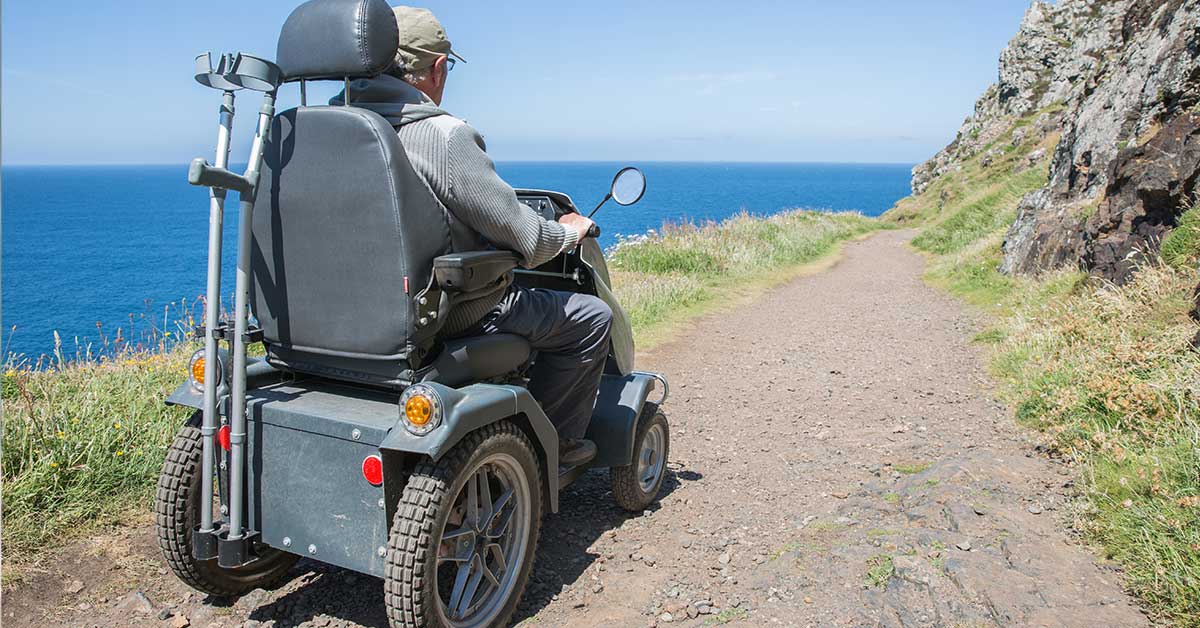
All-Terrain Scooters
All-terrain scooters are for people who refuse to accept that mobility issues mean the end of outdoor adventures.
Features commonly include:
- High ground clearance.
- Large, often knobby tires.
- Strong suspension systems.
- Powerful motors with higher torque.
- Wider, more supportive seats.
These scooters thrive on:
- Grass and park trails.
- Gravel and dirt paths.
- Uneven or rural environments.
They’re also usually big, heavy, and not something you casually bring into a cluttered living room. As with heavy-duty models, they often need a dedicated transport solution.
If your vision of independence involves fishing at the lake, visiting outdoor festivals on rough terrain, or crossing fields to grand kids soccer games, an all-terrain scooter can be life-changing. Just recognize that its much closer to an off-road vehicle than a grocery-store shopper.
Buying a Mobility Scooter
Buying a scooter is part equipment purchase, part healthcare decision, and part lifestyle upgrade. Treat it with that level of seriousness.
A thorough buying process should include:
- Assessment of your mobility condition whether informally or via professionals such as physical or occupational therapists, or via a structured equipment user guide.
- Hands-on trial of at least one or two models, ideally in a space that mimics your real-world environments.
- Review of your home layout, including potential bathroom safety issues and ramps.
- Clear discussion of maintenance: who will manage battery charging, tire checks, and eventual servicing.
I strongly recommend working with a reputable local or regional medical equipment provider like Wrightway Medical rather than gambling on anonymous online sellers. The ability to go back for adjustments, repairs, and training is invaluable.
Insider Tip From a Mobility Retail Manager If a scooter arrives in a box, un-assembled, with no in-person fitting or training, you’re taking on all the risk. Proper seat height, tiller position, and control familiarity can be the difference between confident use and a nasty fall.
Medicare and Mobility Scooters
Medicare can help pay for a mobility scooter, but the rules are narrower than most people realize.
Under Medicare Part B, scooters are considered Durable Medical Equipment (DME) and may be covered only if:
- A physician documents that you have a medical need for a scooter.
- You have limited mobility and cannot perform activities of daily living (like bathing, dressing, or using the bathroom) safely with just a cane, walker, or manual wheelchair.
- You are physically and mentally able to operate the scooter safely.
- The scooter is medically necessary in your home, not just for community outings.
That last point in your home is where many people are surprised. If your doctor believes you can function in your house without a scooter but would simply be more comfortable or independent in the community with one, Medicare may decline coverage. Its frustrating, especially when the emotional and social impacts of limited community mobility are so clear.
Coverage, when approved, is usually partial. You’ll often still pay a portion of the cost, and you must work with a Medicare-enrolled DME supplier. Some people, frustrated by restrictions, choose to pay out of pocket to get exactly the scooter they want.
For those on limited incomes, explore:
- Medicaid programs (varies by state).
- Veterans benefits for eligible individuals.
- Local or state-based assistive technology loan closets and grants.
Frequently Asked Questions
What is the average cost of a mobility scooter?
Most people end up spending between $1,200 and $2,500 on a reliable scooter appropriate for daily use. Travel scooters can be found for under $1,000, while heavy-duty and all-terrain models frequently climb to $3,000$5,000 or more.
The price you should pay depends on your weight, terrain, range needs, and whether you prioritize portability. Buying the absolute cheapest scooter often means sacrificing range, comfort, and long-term durability. On the other hand, paying a premium for features you’ll never use like extra-high top speed doesn’t make sense either.
How long do mobility scooters last?
With routine use and proper maintenance, most quality mobility scooters last 510 years, sometimes longer. Critical components like batteries generally need replacing every 24 years, depending on how often and how far you drive and how consistently you charge them.
Scooters that are ridden near or above their weight capacity, kept outdoors, or used daily on rough terrain may have shorter lifespans. Conversely, units that are protected from the elements, charged correctly, and serviced when issues appear can last far beyond their expected life. Ive personally seen 10+ year-old scooters still in active service after a bit of refurbishment.
Can I get a mobility scooter for free?
Free scooters are rare and typically come through:
- Specific Medicaid programs or waivers.
- Veterans Administration benefits for qualified veterans.
- Nonprofit organizations or community grants.
Some insurance and Medicare plans will cover part of the cost when ordered by a physician, but you’ll usually have co-pays and deductibles. Be very cautious about free scooter advertisements; many are marketing tactics that either bury costs in other fees or lock you into limited options.
Its often more realistic to ask, How can I reduce my out-of-pocket cost? than to chase the promise of a completely free scooter.
Do you need insurance for a mobility scooter?
In many U.S. states, insurance is not legally required for mobility scooters used on sidewalks, in homes, or in stores. However, that doesn’t mean its a bad idea.
Some homeowners or renters insurance policies offer liability coverage that may extend to incidents involving mobility devices, but the details vary. For higher-end or outdoor scooters, especially those used in community areas, some people choose specific mobility device insurance or add riders for theft and damage.
If you plan to ride near roads, in public areas, or own a particularly valuable scooter, its worth speaking with your insurance agent about whats covered and what isn’t.
How fast can a mobility scooter go?
Most standard mobility scooters have top speeds between 4 and 5 mph, mirroring a brisk walking pace. Mid-range and heavy-duty models may reach 68 mph, while some specialized all-terrain scooters can exceed 10 mph.
Higher speed isn’t always better. Safety, stability, and your own reaction time matter far more. In crowded or indoor environments, you’ll rarely use the top speed; most riders dial it down significantly. Think of higher speed as a tool for longer, open stretches not for weaving through grocery store aisles.
Can I take my mobility scooter on an airplane?
Yes, many mobility scooters can be taken on airplanes, but it requires planning. Airlines will:
- Want details about the battery type (most modern scooters use airline-approved sealed or lithium batteries, but rules can be stricter for lithium).
- Treat the scooter as assistive equipment, typically at no extra baggage cost.
- Usually load it as checked equipment at the gate, returning it on arrival.
If you travel frequently, look specifically for airline-friendly or travel scooters, and always confirm airline policies in advance. Foldable or easily disassembled models greatly simplify airport handling.
Can I drive my mobility scooter on the road?
In most U.S. jurisdictions, mobility scooters are intended for sidewalks and pedestrian areas, not regular vehicle lanes. Some local rules allow scooter use on the shoulder or very low-speed roads where no sidewalks exist, but this varies by location.
Scooters typically do not require a drivers license, and aren’t registered like cars or motorcycles. However, you’re still responsible for operating safely and obeying pedestrian-related laws. When in doubt, stay off busy roads and treat the scooter like an enhanced walking aid not a substitute for a car.
Bottom Line
A mobility scooter is not just another piece of medical equipment it’s a decision about how you intend to live the next chapter of your life. If walking pain, fatigue, or balance issues are already shrinking your world, waiting until its really bad doesn’t make you heroic; it just makes you more isolated.
The right scooter for your lifestyle will:
- Match your weight, range, and terrain needs.
- Fit your home, your vehicle, and your daily routine.
- Be reliable enough that you stop thinking about whether it will get you back.
Don’t let price alone, or a flashy photo online, decide for you. Start with a clear-eyed look at your mobility challenges, maybe even in the broader context of daily living challenges and home accessibility. Then choose a scooter type3-wheel, 4-wheel, heavy-duty, travel, or all-terrain that fits those realities.
If you treat this as a serious, personal, and practical decision not an impulse buy you’re far more likely to end up with what you truly need: not just a scooter, but a tool that gives you back places, people, and possibilities you thought you’d lost.