

Compression stockings for seniors are not optional nice-to-haves — they’re medical equipment, as essential as a walker or a grab bar in the bathroom. Chosen and fitted correctly, they quietly prevent ulcers, blood clots, and debilitating swelling. Ignored or worn incorrectly, the price can be frightening: emergency-room visits, chronic wounds that never quite heal, and a gradual loss of mobility that steals independence inch by inch.
Both outcomes are common. One senior goes from barely making it from the recliner to the kitchen, ankles the size of grapefruits, to walking the cul-de-sac twice a day — and the turning point isn’t a surgery or a miracle drug, but the day she starts taking her compression stockings seriously: correct size, correct pressure, worn every morning before her feet hit the floor. Another buys cheap, too-tight stockings online, wrestles them on, gives up after a miserable week, and concludes “compression doesn’t work for me.”
This article exists to keep that second story from being yours. It covers compression stockings for seniors — fit, care, and relief — with specific details, not vague platitudes. If you’re a senior, a caregiver, or a clinician trying to explain this to a stubborn dad or grandma, this is for you.
Compression Stockings for Seniors
You’ll learn how to pick the right fit and compression, put on and care for stockings, and whether they relieve leg pain or qualify for Medicare coverage.
- Fit & selection: measure the ankle, calf, and sometimes thigh; choose knee-high vs. thigh-high; and pick a compression level (15–20 mmHg for mild support; 20–30 mmHg common for venous insufficiency; above 30 mmHg by prescription) for proper fit and relief.
- Wear & care: put them on in the morning (with a donning aid if needed), wear daily as recommended (usually daytime), hand-wash and air-dry, inspect skin, and replace every 3–6 months.
- Relief & coverage: compression reduces swelling, improves circulation, and relieves leg pain for seniors with varicose veins, edema, or DVT risk. Medicare coverage is limited and requires a prescription and documented medical necessity — confirm with your plan.
What Are Compression Stockings?
Compression stockings are tightly knit, medical-grade garments designed to squeeze your legs in a controlled, graduated way — snuggest at the ankle, looser toward the knee or thigh. That gradient is the whole point: it pushes blood and lymph fluid up the leg, back toward the heart, instead of letting it pool in the lower calves and ankles like water in a low spot on the road.
Unlike regular socks or fashion support hose, true medical compression stockings are tested to deliver a specific pressure range measured in millimeters of mercury (mmHg). A stocking labeled 20–30 mmHg is engineered so that, properly fitted, it exerts roughly that pressure at the ankle, with the rest of the stocking calibrated relative to it. That’s why “close enough” sizing isn’t good enough.
Most compression stockings blend nylon and spandex, sometimes with cotton or microfiber for softness, and manufacturers control pressure through the weave and yarn density. That’s why cutting off the toe, rolling the top down, or shortening them with DIY alterations ruins their medical function — you’re not changing the look; you’re changing the physics.
Clinically, compression stockings fall under graduated compression therapy, a noninvasive, first-line treatment backed by decades of vascular research. According to guidelines from the American Venous Forum, properly used compression is standard care for chronic venous insufficiency, lymphedema, and prevention of post-thrombotic syndrome. This isn’t wellness fluff; it carries the same medical seriousness as blood pressure medication.
Insider Tip: If the stockings don’t feel snug, they’re probably not doing anything. If they feel like a tourniquet, they’re the wrong size or compression level. Good compression is firm but tolerable — you forget about it once you’re up and moving.
What Are the Benefits of Wearing Compression Stockings?
The biggest misunderstanding seniors have is that compression is only for people with obvious problems — bulging varicose veins or bandaged legs. In reality, many of the most powerful benefits are preventive, kicking in long before visible damage shows up.
With age, the tiny one-way valves in our veins wear out and start to leak, letting blood slide backward and pool in the lower legs. Compression gives those tired valves mechanical backup. Studies show that moderately strong stockings (20–30 mmHg) can significantly improve venous return and reduce leg volume in people with chronic venous insufficiency, often within hours of wear. In practical terms, that means less ankle and calf swelling by day’s end, reduced heaviness and fatigue (especially after standing), fewer night cramps and restless legs tied to venous congestion, slower progression of varicose veins, and a lower risk of venous leg ulcers — the painful, stubborn wounds that so often lead to home-health or wound-clinic visits.
The change can be dramatic. A senior who insists thick socks are “enough,” then finally switches to properly fitted knee-high 20–30 mmHg stockings after one too many nights of calf cramps, often sleeps through the night within a week — and notices shoes going on easier in the afternoon. Not glamorous, but life-changing in the quiet parts of the day.
There’s also clot prevention. For seniors who travel, sit long hours, or are recovering from surgery, compression is often recommended to reduce the risk of deep vein thrombosis (DVT), especially combined with walking breaks and hydration. According to research cited by the Cochrane Library, graduated compression stockings significantly reduce symptomless DVTs in high-risk patients — the clots that can silently travel to the lungs.
Who Should Wear Compression Stockings?
In one sentence: more seniors should be wearing compression stockings earlier than they think. By the time the legs are weeping fluid and the skin is breaking down, venous disease is already in its late stages. Waiting until then is like waiting to install grab bars until after a fall in the shower.
Seniors who should seriously consider daily compression include those with visible varicose or spider veins that ache; persistent ankle or lower-leg swelling, especially toward evening; a history of DVT, pulmonary embolism, or venous ulcers; long periods of standing or sitting (cashiers, caregivers, drivers, quilters, TV marathons); chronic venous insufficiency, lymphedema, or heart failure (with physician guidance); or medications that cause fluid retention.
Some seniors must talk to a clinician before using stronger compression: those with peripheral artery disease (PAD), advanced diabetes with poor circulation, or active skin infections. If arterial flow is already compromised, compression can be dangerous. A simple ankle-brachial index (ABI) test, available in many primary-care and vascular clinics, clarifies whether compression is safe. In households with a thoughtful aging-in-place plan — grab bars already installed, mobility modifications made — compression stockings usually belong in the same package, because they protect the very thing that makes aging in place possible: the ability to stand, walk, and transfer safely.
Insider Tip: If a senior already needs incontinence supplies or a walker, they’re usually in the zone where compression stockings can prevent the next level of disability — venous ulcers and repeated hospitalizations.
How to Choose the Right Compression Stockings
Fit
Fit is where most people go wrong, and it warrants a strong opinion: if you haven’t been measured at least once, you’re guessing — and guessing with compression is like guessing your eyeglass prescription. Measure first thing in the morning, when swelling is lowest, using a soft tape to record the circumference at the narrowest part of the ankle, the widest part of the calf, mid-thigh for thigh-highs, and the distance from floor to the bend of the knee (knee-highs) or upper thigh (thigh-highs).
Reputable brands provide size charts based on these numbers. If you land between sizes, the answer is not to pick the smaller size “for more compression” — it’s often to switch brands or consider custom-made stockings, especially if your calf and ankle are proportioned very differently. Stocky calves stuffed into a smaller size produce bands digging into flesh, red grooves at the top, and stockings that roll down into a tourniquet — which isn’t just uncomfortable; it can worsen swelling below the band and damage skin.
Insider Tip: If the top band leaves deep dents or the stockings roll down, that’s not “just how they are.” It’s a sizing or style mismatch. Fix it; don’t tough it out.
Length
Length isn’t merely fashion; it changes how pressure is distributed and how likely you are to actually wear them. Knee-highs are often sufficient for swelling limited to the ankles and calves — easier to put on, cooler in warm weather, and compatible with most clothing, which makes them the sensible default when appropriate, because adherence matters more than theoretical perfection. Thigh-highs help when swelling or varicose veins extend above the knee or after certain surgeries, but they slip more, especially on softer or conical thighs, unless they have a good silicone band. Pantyhose/waist-high styles give full-leg coverage and can help with pelvic or buttock varicosity, but they’re the hardest to put on and manage during bathroom trips, particularly for seniors already dealing with incontinence.
A senior who insists on thigh-highs “because that’s what we used in the hospital” often ends up fighting rolling silicone tops every time she sits. Switched to properly measured knee-highs, her actual daily wear time frequently doubles — and her edema improves. Sometimes “good enough but worn faithfully” beats “ideal but mostly in the drawer.”
Style
Style means more than color, though color matters for confidence. Toe style: seniors with toe deformities, bunions, or frequent toenail issues often do better in open-toe stockings with a thin sock over the top if cold; those sensitive to seams may prefer closed-toe. Top band: silicone dots or a wide band for grip, or no silicone for sensitive skin. Material: sheer, opaque, cotton-lined, or microfiber — fragile or easily torn skin usually tolerates opaque or cotton-lined fabrics best. Donning features: side zippers or Velcro wraps aren’t pure stockings, but for seniors with arthritis or limited hand strength, they can be the difference between independence and daily caregiver help.
From a dignity standpoint, style genuinely matters. Self-conscious seniors often re-engage socially once they realize compression now comes in colors, patterns, and sport styles that look like ordinary knee socks — a man who refuses “those old-lady things” will often happily wear black ribbed compression socks that pass for dress socks with his church suit.
Compression Level
Compression level is where your provider’s input matters most, but the numbers are easy to demystify. 8–15 / 15–20 mmHg is light compression for mild tired legs, travel, or very early venous issues, and is generally safe for most people. 20–30 mmHg is moderate compression — the workhorse for most seniors with noticeable swelling, varicose veins, or post-DVT management. 30–40 mmHg and above is strong compression, typically reserved for advanced venous disease, lymphedema, or post-ulcer care, and usually requires a prescription and supervision.
For a senior with clear indications (swelling, visible varicosities, history of clots), 20–30 mmHg knee-highs are often the realistic starting point — provided arterial circulation is adequate. Starting at 8–15 mmHg when you already have significant edema is like turning on a fan during a heat wave and calling it air conditioning. According to vascular guidance summarized by UpToDate, 20–30 mmHg hits the sweet spot of effectiveness and tolerability in chronic venous insufficiency. And if you can only tolerate 20–30 for an hour, the problem is usually sizing or material, not the pressure itself.
Insider Tip: Pair compression with calf-pump exercises. Every time you point and flex your ankle inside that stocking, you turn your leg into a second heart helping push blood upward.
How to Put on Compression Stockings
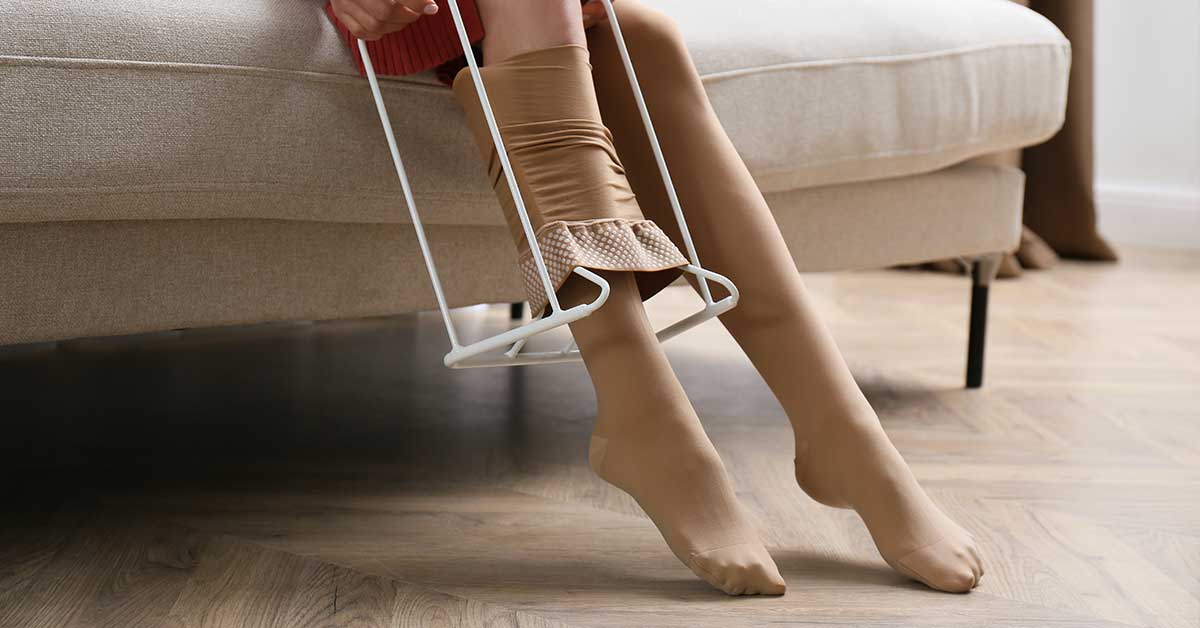
The blunt truth: putting them on is usually the most frustrating part, especially with arthritis, limited flexibility, or shortness of breath. Technique and tools make a huge difference. Start early in the morning before the legs swell. Sit on the edge of the bed or a chair with good back support. Turn the stocking inside out to the heel, leaving the foot portion right-side out (a little toe pocket). Insert your foot, lining up heel and toes. Gently work the stocking over the heel and ankle, then up the calf in small sections, smoothing wrinkles as you go — never yank from the top only. Finish with the fabric smooth, with no folds or bunching, especially behind the knee.
If that still sounds impossible, donning frames (“stocking butlers”), rubber gloves for grip, and silk foot slips for open-toe styles can transform the process — even fiercely independent nonagenarians go from needing daily caregiver help to managing solo once shown the right frame and technique. For seniors juggling other supplies, such as catheter or specialty needs items, a consistent morning routine helps: stockings go on after toileting and skin checks and before breakfast, as part of a “protect my legs for the day” ritual.
Insider Tip: If you’re getting out of breath putting them on, do it in stages with rest breaks, or ask for an evaluation for a donning aid. Struggling every morning means you need better tools — not that compression isn’t for you.
How to Care for Compression Stockings
If fit is mistake #1, care is mistake #2. Compression stockings aren’t cheap, and seniors often stretch a single pair far past its useful life, figuring “no hole, still fine.” But the elastic memory fades gradually, long before visible wear. Hand-wash or use a gentle cycle in lukewarm water with mild detergent (harsh detergents, bleach, and fabric softeners break down fibers). Never wring or twist aggressively — roll them in a towel and press out the water. Air-dry only, away from direct heat or sun; dryers, radiators, and hot dashboards destroy elasticity. And rotate multiple pairs so each can rest and recover between wears.
Well-cared-for stockings worn daily maintain useful compression for roughly 4–6 months; beyond that they become “comfortable” in the worst way — too stretchy to do much. A simple test: if you can easily stretch the ankle wider than your hand with little resistance, it’s time to replace them. This ties into aging-in-place budgeting — like mobility aids or incontinence supplies, compression stockings are consumables with a lifespan, not one-time purchases.
Insider Tip: Write the start date on the packaging or on a piece of tape in your drawer. When you hit six months of daily wear, replace them whether they look worn or not. Your veins will thank you.
How Long to Wear Compression Stockings
“Do I really have to wear them all day?” For most seniors with venous disease, the honest answer is yes — with nuance. Put them on within 30 minutes of waking, before swelling builds. Wear them throughout the day while upright — sitting, standing, or walking. Remove them at bedtime unless a clinician instructs otherwise (certain post-surgical protocols, for example). If you nap, you don’t necessarily need to take them off, but if you lie flat for several hours and they’re uncomfortable, it’s reasonable to remove and re-don later. The key is consistency over weeks and months, not perfection every hour.
Skeptics often come around with a simple experiment: a photo of the legs at 8 p.m. each night for a month, with and without compression. By week two, the difference is usually undeniable — sock marks nearly gone, skin less shiny and tight, and the walk to the mailbox less of a chore.
Do Compression Stockings Help Leg Pain?
Not all leg pain is venous, and compression is no cure-all. But for pain caused by venous congestion — aching heaviness, throbbing around varicose veins, burning discomfort that worsens with standing and eases with elevation — compression can be remarkably effective. Heaviness and fatigue often improve substantially as pooling stops. Aching around varicose veins usually decreases within days to weeks once veins are supported. Night cramps frequently lessen as daytime swelling is controlled (though electrolytes matter too). And that tight, “about to burst” skin sensation eases as circulation prevents extreme evening edema.
However, shooting pains, numbness, or calf pain that worsens with walking and improves with rest can point to arterial disease or neuropathy rather than venous issues — and there, compression can be unhelpful or harmful. Any new or unexplained leg pain deserves evaluation, not just a quick trip to buy stockings. With the right indication, seniors who rate their leg discomfort an 8 out of 10 by dinnertime commonly drop to a 3 within two weeks of consistent 20–30 mmHg wear — turning “I have to sit down right now” into “I can finish my errands and then rest.”
Insider Tip: If pain improves noticeably when the legs are elevated on a pillow and returns when they’re down, compression stockings are very likely to help. That pattern screams venous.
Are Compression Stockings Covered by Medicare?
Here’s where expectation crashes into reality. Most seniors assume Medicare covers compression stockings the way it covers other durable medical equipment. Unfortunately, Medicare generally does not cover compression stockings for routine or preventive use, even when prescribed.
Medicare Part B may cover compression garments only in specific circumstances: after a venous stasis ulcer has developed and is being actively treated; as part of post-surgical care in certain hospital or skilled-nursing settings; and, for lymphedema, under the Lymphedema Treatment Act, which since 2024 has extended Part B coverage to gradient compression garments prescribed for lymphedema with proper documentation. For the typical senior managing chronic venous insufficiency or mild-to-moderate edema at home, compression stockings are usually an out-of-pocket expense. Some Medicare Advantage plans, Medigap policies, or employer retiree plans offer better coverage, so check with your insurer directly.
The practical takeaway: plan for compression the way you’d plan for other non-covered essentials of aging in place, like certain bathroom safety modifications or quality incontinence briefs — an investment in preventing something far more expensive and disabling: chronic wounds, hospitalizations for cellulitis, or post-DVT complications.
Insider Tip: Ask your doctor for a detailed prescription and diagnosis codes even if you’re paying cash. Some secondary or retirement plans reimburse retroactively — but only with proper documentation.
Conclusion: Compression Stockings as Quiet Guardians of Independence
“Fit, care, and relief” isn’t a slogan; it’s a blueprint. Get the fit right with accurate measurements and realistic style choices, care for the stockings so they keep their medical-grade power, and commit to daily wear — and you’re not just managing swelling. You’re protecting your mobility, your skin, your sleep, and by extension, your independence.
Too many seniors lose ground not to dramatic strokes or sudden accidents, but to slow, preventable venous disease that nobody took seriously until the legs were wrapped, weeping, and too painful to walk on. Compression stockings won’t prevent every problem, but they’re one of the most effective, underused tools for keeping seniors living at home, on their own terms, for longer. If you or someone you love is already thinking about aging in place — planning bathroom safety, mobility aids, or other supports — compression stockings belong on that same checklist. Get measured. Choose wisely. Budget for replacements. Wear them like you’d take a daily heart pill: not because you enjoy it, but because you like what your life looks like when you do.
The choice, in the end, isn’t between stockings and no stockings. It’s between supported circulation that keeps you on your feet, and the silent slide into leg ulcers, repeat hospital stays, and dependence that could have been postponed or prevented. If that sounds dramatic, spend one afternoon in a wound-care clinic — or better yet, spend it walking your neighborhood in well-fitted compression stockings, and feel the difference in your own legs.