

Table of Contents
- Choosing Your Catheter Type
- What is catheterization?
- What are catheters used for?
- What are the different types of catheters?
- How do I choose the right catheter?
- How do I use a catheter?
- How do I care for a catheter?
- What are the risks of catheterization?
- When should I contact a healthcare provider?
- Conclusion
- Questions and Answers
- What is the main difference between straight tip and coudé tip catheters?
- Who should consider using a coudé tip catheter over a straight tip?
- How do I decide if a straight tip or coudé tip catheter suits me best?
- What are the advantages of a straight tip catheter?
- Can a coudé tip catheter cause discomfort during use?
- Is it safe to switch from a straight tip to a coudé tip catheter on my own?
Catheterization is one of those medical realities that most people don’t want to think about until they suddenly have no choice. And here’s the blunt truth: the difference between a miserable experience and a manageable one often comes down to the details people gloss over, especially the question of straight tip vs. coudé tip catheters: which type is right for you? Ive seen people suffer for months with pain, leakage, and infections simply because no one took the time to match the catheter type to their anatomy, condition, and lifestyle.
This guide is unapologetically practical. It’s written for people who either use catheters, are about to, or care for someone who does, and who are tired of vague, sugarcoated explanations. We’ll talk about what catheterization really is, why it’s used, the different types (including when a coudé tip isn’t just nice to have but essential), how to use and care for a catheter, and how to know when something is wrong. I’ll weave in clinical facts, but I’ll also pull from real-world patient experiences and what I’ve heard repeatedly from nurses, urologists, and longtime catheter users.
Choosing Your Catheter Type
Learn how to select between straight tip and coudé tip catheters based on your needs. – Straight tip catheters are typically used for general catheterization, ideal if you have a normal urethra without obstructions. – Coudé tip catheters have a curved, tapered tip designed to navigate around obstructions like an enlarged prostate, making them suitable if you experience difficulty inserting a straight tip. – Proper catheter choice depends on your anatomy and medical condition, so consulting a healthcare provider can help determine the best type for safe and effective use.
What is catheterization?
Catheterization is the process of inserting a thin, flexible tube (a catheter) into the body to drain urine from the bladder. In most cases were talking about urinary catheterization, where the catheter is passed through the urethra into the bladder. The goal is simple: let urine out when your body cant do it reliably or safely on its own. But while the goal is simple, the method isn’t trivial, and getting it wrong can have consequences that last far longer than the catheter itself.
In clinical practice, catheterization is used on everyone from newborns with congenital urinary tract issues to older adults recovering from surgery or managing chronic conditions. According to data from the CDC, up to 25% of hospitalized patients receive a urinary catheter at some point during their stay. That’s not a niche procedure tha’ts mainstream medicine. Yet many patients tell me they got only a 2minute explanation and a pamphlet, if that.
I still remember a man in his 60s who told me his first catheterization in the ER felt like being ambushed. No one explained why they were using a straight tip catheter, even though he had a known enlarged prostate. It took a urology consult and a switch to a coudé tip catheter before he could urinate without intense pain and repeated blockage. That’s how central catheter choice can be to the entire experience of catheterization.
What are catheters used for?
Catheters are used whenever the normal flow of urine is disrupted, unsafe, or requires close monitoring. The reasons fall into a few major categories, but the why matters just as much as the what, because it influences which catheter type and tip make sense.
Common reasons include:
- Urinary retention (you cant empty your bladder fully or at all)
- Bladder outlet obstruction, often from an enlarged prostate (BPH), strictures, or tumors
- Neurologic conditions like spinal cord injury, multiple sclerosis, or spina bifida
- Postsurgical care, especially after pelvic or urologic procedures
- Severe incontinence when other methods fail or aren’t practical
- Accurate urine output monitoring in critical illness
In a neurogenic bladder (where nerve signals to the bladder are impaired), intermittent catheterization can literally preserve kidney function. For people with urinary incontinence, especially when combined with mobility challenges, external catheters or carefully managed indwelling catheters can mean the difference between skin breakdown and infection versus staying dry and socially active. If you’re exploring incontinence more broadly, Wrightway’s resources on urinary incontinence and incontinence and bladder health are a useful complement to this guide.
What often gets overlooked is that catheterization isn’t just a medical necessity; it’s a quality of life intervention. Ive seen young adults with spinal cord injuries go from planning their day around bathroom access to planning it around work, travel, and relationships once they were matched with the right catheter system and taught to use it safely.
What are the different types of catheters?
The three big categories you’ll hear about are:
- Intermittent catheters
- Indwelling catheters (Foley catheters)
- External catheters
Each of these can come with different tips (straight vs. coudé), materials (latex, silicone, PVC), and coatings (hydrophilic, prelubricated, uncoated). The choice isn’t cosmetic; its functional.
If you’re already thinking about straight tip vs. coudé tip catheters: which type is right for you?, it helps to understand that:
- Straight tip catheters are the default, general purpose option.
- Coudé tip catheters have a slight curve at the end, designed to navigate around obstructions, especially in people with enlarged prostates, urethral strictures, or anatomical variations.
Let’s break down the main catheter categories first, then we’ll circle back to choosing the right style and tip.
Intermittent catheters
Intermittent catheters are inserted to drain the bladder and then removed right away. No balloon, no bag left in place. For many patients, especially those with chronic retention or neurogenic bladder, this is the gold standard because it dramatically reduces infection risk compared to long-term indwelling catheters.
There’s a strong body of evidence showing that clean intermittent catheterization (CIC) done several times a day is safer long-term than leaving a Foley catheter in place. For example, urology guidelines from the AUA consistently favor CIC for many neurogenic bladder situations. In practice, I’ve seen patients who moved from years on an indwelling catheter (with recurrent UTIs and hospitalizations) to intermittent self-catheterization and saw their infection rate plummet.
Intermittent catheters come in:
- Straight tip: best for people with a relatively unobstructed urethra; often used in women, children, and men without significant prostate enlargement.
- Coudé tip: often recommended for men with BPH, urethral strictures, or a history of difficult catheterizations. The slight bend can help the catheter ride over the prostate and into the bladder instead of poking into the urethral wall.
From a practical standpoint, I’ve found that people who switch from a straight to a coudé tip after repeated difficulty often describe it as night and day. One middle-aged man with longstanding BPH told me he went from needing help every time to self-cathing independently once his urologist prescribed a coudé intermittent catheter.
Indwelling catheters
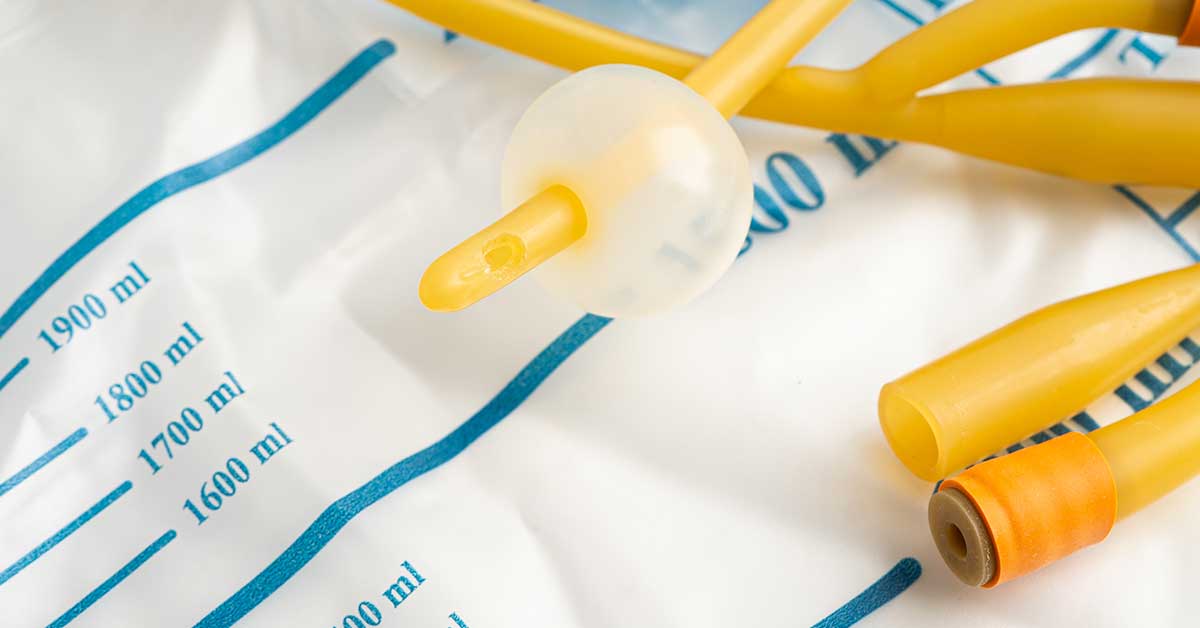
Indwelling catheters, often called Foley catheters, stay in place for days to weeks. They have a small balloon near the tip, inflated with sterile water, to keep the catheter from slipping out of the bladder. The other end connects to a drainage bag, either a larger bedside bag or a smaller leg bag for mobility.
Indwelling catheters are essential in certain situations: major surgery, acute urinary retention, severe illness, or when someone cannot perform intermittent catheterization and has no reliable caregiver. They’re also sometimes used in complex cases of incontinence where all other options have failed. However, they come with a much higher risk of catheter-associated urinary tract infections (CAUTIs). The CDC notes that indwelling urinary catheters are a leading cause of healthcare-associated infections.
Indwelling catheters also come in straight and coudé tip versions. In hospitals, many providers reflexively reach for a standard straight Foley, but in older men with large prostates or known strictures, a coudé Foley can dramatically reduce trauma and failed attempts. I’ve watched a situation where three failed straight catheter attempts left a patient bleeding and distressed, only for a more experienced clinician to walk in, choose a coudé Foley, and succeed in one gentle pass.
External catheters
External catheters (sometimes called condom catheters for men, and newer external collection devices for women) sit outside the body and channel urine into a bag. They don’t enter the urethra at all, which means much lower risk of urethral trauma and infection.
For men, a condom style sheath is rolled over the penis and connected to tubing and a bag. For women, newer external devices use soft, absorbent pads or suction systems that sit on the urethra. These are particularly popular in hospitals to reduce CAUTI rates, and studies in critical care settings have shown that external devices can significantly lower infection rates compared to indwelling catheters.
External catheters are especially helpful in incontinence management for people who are bed-bound or have dementia, where frequent toileting or pads lead to constant skin breakdown. If you’re exploring broader support products, Wrightway’s incontinence supplies and specialty needs supplies can be integrated with external catheter systems to create a more dignified, less invasive routine.
How do I choose the right catheter?
Choosing the right catheter is not about grabbing whatever the hospital sent you home with and hoping for the best. It’s a decision that should involve your urologist, primary care provider, or continence nurse and, frankly, your own comfort and preferences.
Key factors include:
- Reason for catheterization (retention vs. incontinence vs. monitoring)
- How long will you need it (days, months, lifelong)
- Your anatomy (male/female, prostate size, urethral strictures, pelvic surgeries)
- Your hand function and mobility (can you self-cath?)
- Infection history and skin sensitivity
- Lifestyle (work, travel, sports, intimacy)
Straight tip vs. coudé tip catheters: which type is right for you?
Here’s where I take a firm stance: if you are a man with a known enlarged prostate, urethral stricture, history of difficult catheterizations, or repeated painful attempts with straight catheters, you should absolutely be discussing coudé tip catheters with your provider.
Straight tip catheters are typically right for:
- Most women and children
- Men without significant prostate enlargement or urethral narrowing
- Situations where prior straight catheterization has been easy and painless
- People who prefer a simpler, familiar option and have no history of difficulty
Coudé tip catheters are often better for:
- Men with benign prostatic hyperplasia (BPH)
- People with urethral strictures or scarring
- Anyone with repeated false passages or bleeding during straight catheter attempts
- Cases where the catheter tends to catch or stop partway in
The coudés curved tip lets the catheter follow the natural upward curve of the male urethra and slip past the prostate more easily. In my experience, the people who benefit most from coudé tips are the ones who’ve been told for years that catheterization just hurts. Once they switch, they realize it didn’t have to.
Insider Tip (from a urology nurse of 20+ years): If a male patient tells you it always hurts right about here and points behind the scrotum or at the base of the penis, and you’re using a straight catheter, that’s your cue to consider a coudé. Pain at the same point every time usually means you’re fighting the anatomy, not the patients pain tolerance.
Beyond tip shape, you’ll also need to choose:
- Catheter size (French, Fr): Too small can leak; too large can cause trauma. Most adults use 1216 Fr.
- Length: Male, female, or pediatric lengths.
- Material: Silicone (good for latex allergy, longterm use) vs. latex or PVC.
- Coating: Hydrophilic or prelubricated catheters can reduce friction and urethral trauma, especially in frequent intermittent users.
If you’re sourcing supplies yourself, a curated range of catheter supplies, like those at Wrightway’s catheter supplies page, and consumable medical supplies can help you avoid trial and error with low-quality products.
How do I use a catheter?
Technique matters. The same catheter can be safe and comfortable in one person’s hands and risky in another’s. Below is a practical overview, not a substitute for in-person teaching, but a framework to help you know what to ask and expect.
Intermittent catheterization
With intermittent catheterization, you insert, drain, and remove. It’s usually done every 46 hours, depending on your fluid intake and bladder capacity.
Typical steps (your exact instructions may vary):
- Wash your hands thoroughly.
- Prepare supplies: catheter, lubricant (if needed), mirror (if helpful), collection container or toilet.
- Clean the urethral area with soap and water or wipes.
- Lubricate the catheter if it’s not prelubricated.
- Position yourself: seated on a toilet, wheelchair, or bed, or standing if you’re stable.
- Insert the catheter gently until urine flows. For coudé tips, make sure the curve is oriented as instructed (often up toward the ceiling).
- Allow the bladder to empty fully, then slowly withdraw the catheter, pausing if more urine flows.
- Dispose of or clean the catheter as directed (most modern catheters are single-use).
A patient with MS once told me the game-changer wasn’t just learning the steps, but also learning how to adapt them on bad fatigue days, keeping a small, organized kit in the bathroom and one in her bag, and using pre-lubricated hydrophilic catheters to reduce effort.
Insider Tip (from a rehab specialist): For self catheterization, set up your space so you can do it the same way every time. Muscle memory is your friend. People who standardize their routine have fewer oops moments, fewer skipped caths, and fewer emergency room visits for retention.
Indwelling catheterization
If you have an indwelling catheter, you’re not inserting it yourself (unless you’re specifically trained and instructed to do so, which is rare). Your job is to manage the system:
- Keep the drainage bag below the level of your bladder (to prevent backflow).
- Make sure there are no kinks in the tubing.
- Empty the bag regularly before it’s overly full.
- Keep the catheter secured to your thigh or abdomen to prevent tugging.
- Maintain good hygiene around the urethral opening.
For many people at home, switching between a leg bag during the day and a larger bedside bag at night offers the best balance of mobility and sleep. If you’re pairing this with other support equipment, Wrightway’s durable medical equipment and bathroom safety resources can help you build a safer environment around your catheter use.
External catheterization
Using an external catheter is more about fit and skin care than insertion technique.
For men with condom catheters:
- Clean and dry the penis thoroughly.
- Trim (don’t shave) hair if needed to prevent painful removal.
- Roll on the condom catheter like a condom, leaving a small space at the tip.
- Smooth out wrinkles and ensure good contact without constriction.
- Connect to the drainage tubing and bag.
For women, external devices are placed over the urethra as directed, often with gentle suction or an adhesive to keep them in place. Nurses in hospitals have told me that once they switched female patients from indwelling Foley catheters to external devices, they saw not only fewer infections but also less agitation and pulling at lines, especially in people with dementia.
How do I care for a catheter?
Catheter care is where the difference between living with a catheter and suffering with a catheter becomes stark. Good care reduces infections, blockages, and skin breakdown.
General principles:
- Hand hygiene: Always wash before and after touching the catheter or bag.
- Daily cleaning: Gently clean the area around the urethra with mild soap and water. No harsh antiseptics unless specifically instructed.
- Securement: Use a leg strap or securement device to prevent tugging.
- Drainage bag care: Don’t let the bag touch the floor. Empty when 2/3 full. Rinse and clean reusable bags as instructed.
- Hydration: Unless your provider tells you otherwise, drink enough fluids to keep your urine pale yellow. This helps reduce sediment and blockages.
For intermittent catheter users, storage and handling matter. Don’t toss catheters loosely into a bag where they’ll get contaminated. Many people keep a small pouch or kit with sealed catheters, lubricant, and wipes. If you’re juggling multiple medical needs, integrating catheter care into your broader supply setup using organized incontinence supplies and specialty needs supplies can make your routine far less chaotic.
Insider Tip (from a home health nurse): If you’re seeing thick, cloudy sediment in the tubing every day, don’t just shrug it off. It might be normal for you but it might also be an early sign of infection or that your catheter size, material, or change schedule needs adjusting.
What are the risks of catheterization?
No matter how carefully you do it, catheterization carries risks. The goal is not to eliminate them entirely, that’s impossible, but to minimize and manage them.
Common risks include:
- Urinary tract infections (UTIs) and catheter-associated UTIs (CAUTIs)
- Urethral trauma (scrapes, tears, false passages)
- Bladder spasms and discomfort
- Blockages from blood clots, sediment, or kinks
- Skin breakdown and irritation around the urethra or where devices contact the skin
- Bladder stones with longterm indwelling catheter use
Indwelling catheters carry the highest infection risk because bacteria can travel along the catheter and form biofilms inside it. According to CDC estimates, each day an indwelling catheter remains in place increases the risk of infection. That’s one reason many clinicians push for intermittent or external options whenever feasible.
I’ve met people who assumed frequent burning, cloudy urine, and low-grade fevers were just part of life with a catheter. They weren’t. Once they had their system reassessed, sometimes switching from an indwelling straight catheter to a coudé intermittent system, or from a Foley to an external device, their infection rate dropped dramatically.
When should I contact a healthcare provider?
If you use any kind of catheter, you need a low threshold for calling. Problems escalate fast when urine flow is involved.
You should contact your healthcare provider if you notice:
- Fever, chills, or feeling generally unwell, especially with catheter use
- Cloudy, foul-smelling, or bloody urine that’s new or worsening
- Burning, pain, or pressure in your lower abdomen, pelvis, or back
- Little or no urine is draining into the bag despite usual intake
- Leaking around the catheter (bypassing)
- New swelling, redness, or discharge around the urethra
- Recurrent blockages or need for frequent catheter changes
And here’s my strong opinion: if you’re repeatedly having painful catheterizations, especially as a man, and no one has yet mentioned coudé tip catheters, you should be asking why. That’s a conversation worth insisting on with your urologist.
For people managing broader continence issues, urinary plus bowel incontinence, frequent falls, or bathroom safety concerns, looping in a provider early can help you design a comprehensive plan. Wrightway’s resources on bowel incontinence, bathroom safety, and durable medical equipment can be part of that bigger picture.
Insider Tip (from a urologist): If you’re on your third UTI in six months with a catheter, that’s not bad luck. That’s a system problem. It might be the catheter type, the tip, the change schedule, or the technique but something needs to change.
Conclusion
Catheterization is not just a tube in the bladder. It’s a complex, deeply personal medical intervention that touches every part of daily life, from how you sleep to how you travel to how you feel about your own body. The industry and even some clinicians still treat it as an afterthought, handing out generic straight catheters and minimal instructions. That’s not good enough.
The reality is that details like straight tip vs. coudé tip catheters: which type is right for you? can determine whether catheterization feels like a constant battle or a manageable routine. If your anatomy or history makes catheterization difficult, a coudé tip may not just be more comfortable, it may be the only rational choice. If you can manage intermittent catheterization instead of an indwelling Foley, your long-term health will likely be better for it. If an external catheter can replace an internal one, your risk of infection and discomfort may drop dramatically.
You deserve more than here’s your catheter, good luck. You deserve a tailored plan: the right type, the right tip, the right size, and the right supplies plus clear guidance on use, care, and warning signs. Use this guide as a springboard for specific, pointed conversations with your healthcare team, and don’t be shy about pushing for options that respect both your health and your quality of life.
Questions and Answers
What is the main difference between straight tip and coudé tip catheters?
Straight tip catheters have a straight end, while coudé tips are curved for easier navigation.
Who should consider using a coudé tip catheter over a straight tip?
Patients with enlarged prostate or urethral strictures may benefit from coudé tip catheters.
How do I decide if a straight tip or coudé tip catheter suits me best?
Consult your healthcare provider to assess your anatomy and medical needs for proper catheter choice.
What are the advantages of a straight tip catheter?
Straight tip catheters are easier to insert and suitable for most patients without obstructions.
Can a coudé tip catheter cause discomfort during use?
While coudé tips may feel different, they are designed to reduce trauma and ease insertion in difficult cases.
Is it safe to switch from a straight tip to a coudé tip catheter on my own?
No, always consult a healthcare professional before changing catheter types to avoid complications.